Hyacinths will bloom soon. The weather is warming. Most of the snow is melted, though the lake is still covered in ice.
I have a terrible cold. Hoping it will pass. I feel a little like Gandalf in the caves of Moria, when he thinks he has escaped the monster, only to be felled by a last whip of light. I thought I had gotten through the winter without a cold ... and now this. The only redeeming quality to a cold is it reminds me how much more vigorous I usually am.
It is late for the hyacinths to bloom but it has been a very cold winter. It seems to me in Maryland we would see them in February.
My father, if alive, would have turned 91 today, Pi Day. We never used to call it that. He died a few weeks shy of his 80th birthday, during a nap. Not a bad way to go, at home, in peace. Eighty good years are fine. I still remember the sense of peace that emanated from the bedroom after my brother called me and we got there. His father died the same way, just shy of 80, in his case simply not waking up one morning. I would not be sorry to have such an end. Of course, with spring coming, new life is on my mind as well.
I am also almost done with my Bonhoeffer MS and could be done if I would just get well. And I believe I will. :)
Roger is very kind to me in my fallen, miserable state. I sometimes think kindness is all the world needs more of.
“Don’t worry about what the world needs. Ask what makes you come alive and do that. Because what the world needs are people who have come alive.” Howard Thurman
Saturday, March 14, 2015
Wednesday, March 11, 2015
March 11th, Barnesville
It was heavily foggy this morning when I left, but I didn't think to take a picture. The fog was so thick and white it was eery, especially hanging over the lake, and the sun was not quite up. It was dark, appropriate for doing "House of Usher" in class.
I am sick with a cold. My throat is sore, my eyes itchy, everything is slow-motion. I can't do real intellectual work and maybe that is a gift. I could clean and I did. Students are coming over tonight to watch Apocalypse Now. I can blog and I am.
I did take a mid-afternoon photo, below. It's still overcast and through the trees you can catch glimpses of what looks like fog but is ice on the lake. All the snow has melted after all these months, except for a few patches, that look like some sort of fungi. It's warm, springlike.
I took a second picture this afternoon. This one above is to the west. The one below is the south view.
How I see space has changed since moving here. I think for the first year or more I just didn't see how much space we had around us or how big our yard was. My eyes had adjusted to small, and just couldn't take in large. I notice the opposite effect when we are in York. Roger's parents' quarter-acre yard now seems tiny. My eyes jump over it and into the yard behind it, as if were a prelude. It's odd, because before, my eyes fell right on their backyard and I didn't notice much beyond it. There's a metaphor here, that we see what we're trained to see. How much do we miss?
I like the empty space here, the vistas.
I am grateful for how the head cold slows me down and for being able to be at home. I read today wise words: "hold fast what is good." (1 Thess. 5-21) Hold fast what is good or you will lose it. I thought about what is good, so much good around me.
It is so quiet right now that you can hear the stillness. I think the birds must be glad of the warmth.
I am sick with a cold. My throat is sore, my eyes itchy, everything is slow-motion. I can't do real intellectual work and maybe that is a gift. I could clean and I did. Students are coming over tonight to watch Apocalypse Now. I can blog and I am.
I did take a mid-afternoon photo, below. It's still overcast and through the trees you can catch glimpses of what looks like fog but is ice on the lake. All the snow has melted after all these months, except for a few patches, that look like some sort of fungi. It's warm, springlike.
I took a second picture this afternoon. This one above is to the west. The one below is the south view.
How I see space has changed since moving here. I think for the first year or more I just didn't see how much space we had around us or how big our yard was. My eyes had adjusted to small, and just couldn't take in large. I notice the opposite effect when we are in York. Roger's parents' quarter-acre yard now seems tiny. My eyes jump over it and into the yard behind it, as if were a prelude. It's odd, because before, my eyes fell right on their backyard and I didn't notice much beyond it. There's a metaphor here, that we see what we're trained to see. How much do we miss?
I am grateful for how the head cold slows me down and for being able to be at home. I read today wise words: "hold fast what is good." (1 Thess. 5-21) Hold fast what is good or you will lose it. I thought about what is good, so much good around me.
It is so quiet right now that you can hear the stillness. I think the birds must be glad of the warmth.
Sunday, March 1, 2015
Snow Fort at Olney Friends School
| Olney snowfort. If you look hard, you can see the circa 1910 Hutton House in the background. |
When I saw a snow fort on the Olney campus, built by teacher and alum Jamie Zavitz and students, it captured my imagination, and I couldn't help but think of a book I read as a child:
That book really makes you want to build a snow fort. So I was delighted to see one at Olney. It made me wish I had gone to the school.
According to the web, The Wonderful Winter Secret was published in 1931, but I remember it having a pre-World War I feeling.
Whatever the date, there's a timeless quality to a snow fort, which seems to fit Olney.
Saturday, February 28, 2015
Quakers, Zombies, Propaganda, Boomers
I saw this yesterday:
As a Boomer (I was born in 1958) I never thought of Boomers as Zombies or vice versa. I have my own ideas of who the Zombies are ... and my own theories help me realize that, in fact, Zombies are the palimpsest on which we write our own script ... or do we? Or are they part of a propaganda machine?
The piece I quote from above saddened me because it revealed that some Gen Xers have fallen victim to the ceaseless propaganda put out by the forces of evil, propaganda meant to separate and put into competition groups whose interests actually align. Pitting Boomers against Gen-Xers sounds to me similar to the propaganda used to separate poor whites from poor blacks: those blacks are taking the money from your pockets, the food from your mouths and they are the Other... better keep 'em down.
The blog post thus mouths all the correct propaganda: greedy, self-centered Boomers are robbing the younger generation of their rightful legacy.
It's true, isn't it? Social Security and Medicare will take up a larger portion of federal budgets as Baby Boomers retire, and hence, Boomers are sucking tax dollars out of hardworking younger people who could be using that money for other things. At the same time, as fixed pension retirements decline and the ability to survive on Social Security diminishes, Boomers are, by necessity, staying in their jobs longer and longer--jobs that could and should, the logic follows, go to the younger generation.
From where I stand the above is a lie.
Let's say the "burden" of Social Security and Medicare went away: who is going to end up supporting now impoverished parents? Yes, you guessed it: You. Is this going to cost you LESS, financially and emotionally, than paying into the current system? Do you REALLY WANT Mom and Dad--decrepit Zombie Mom and Dad--moving in with you? Or, do you really want, alternatively, to be sending them $500 a month to keep them away? Really? What if your spouse's parents don't need the money and yours do and your spouse burns with resentment every month at sending off the check? Is this the route to marital harmony? Or do you let Mom and Dad go hungry? And what about those other Zombies who don't have children willing to support them? Do they starve? Hhmm.
I can remember in the early 1970s reading article after article about the hit TV series The Waltons, the heart warming saga of an intergenerational family surviving during the Depression. For most of the critics, The Waltons represented living memory, and most fixated on the grandparents living with the family, something they all remembered vividly. They all marveled at that social organization having passed into oblivion. I, on the other hand, couldn't imagine my grandparents living with us ... nobody I knew had grandparents living in the same house ... or if I did imagine it, all I could picture was an endless amount of sturm and drang. I was glad those "good old" days were gone ... do we want those days back? Are we all likely, REALLY, to all be cosy and prayerful together like the Waltons, everyone leaning into the old folks' wisdom? Do you want this Gen-Xers? Mom interfering in raising the kids, spending your money or taking over your kitchen? Dad telling you what to do, how to take care of your car, or talking endlessly about Viet Nam protests? Maybe some do, but it's always nice to have the option to say no.
Of course, another solution is euthansia: we could just kill all the Zombies. But most people, in my experience, seem oddly revulsed by that idea of snuffing Mom and Dad. And then the X-ers themselves would become the next generation of Zombies ...
But what about jobs? Aren't Boomers really clogging up the job market? Well, yes and no. Yes, Boomers are retiring later. On the other hand, it has come to my attention that many of the plum jobs that Boomers have tend to vaporize after the Boomers in question retire. I remember Newton Garver coming to Earlham School of Religion and telling us that the state university system of New York, where he worked as a philosophy professor, was going to abolish his job once he retired. No hungry philosophy Phd would benefit from him leaving. So, although in his early 80s (he has since died), he planned to keep working until death, and as his expenses were low and salary high, he was funneling much of his money, as I understand it, to help Bolivian Quakers. In other words, rather than harming the younger generation, his staying in his job was helping the younger generation to get a start in life. And once he was gone, the job was gone. Gone, gone, gone. This is simply one example, but I could conjure up story after story after story of the person who retires only to have his or her good job either divvied between the remaining employees, vaporized or offered up at much lower pay and benefits and with much less security to a younger person.
I'll try to cut this short, but what of the other side? What of all that Boomers DO and have done for the younger generations? Speaking for myself and the cohort I know, we have put or are putting our children through college at a level of sacrifice we never expected. Our lush salaries that you look at with such envy have flat-lined (if we're lucky enough not to have taken cuts) and college costs keep going up. And yet we keep finding the money ... somewhere. That's only the beginning of what we do for you... but this isn't the point--we WANT to do it, and pointing it out only feeds the evil.
Because, despite the propaganda saying our generation is "stealing" from yours, the reality is, we're all in this together. WE, your parents and older friends, are NOT the ones stealing your future...SOMEONE is, but it's not US.
Since Leonard Nimoy just died, I have been thinking about the original Star Trek. In one episode, an alien entity that feeds on hate gets Earthlings and their enemies, the Klingons, together and fosters violent dissent between them through telling lies ... then sits back and grows stronger and stronger as they fight each other. In Star Trek, the rival groups figure it out and work together: THEY STOP FIGHTING and the power of evil diminishes before our eyes.
The Bible says something about this too. Who benefits when the generations are at each other throats? Who has told us the lie that it's a zero sum game? Why would we ever believe that we have to rob each other to have what we need? Why would we think any of us, or the government--which is us--is the Zombie? Isn't there a rival story, called feeding the 5,000? Do we believe that? I do.
What does this have to do with Quakers? Obviously, quite a number of Quakers are Boomers, products of an anti-war and pro-people movement that dovetailed with Quaker values. It can be hard being a younger Quaker, even for me, a younger Boomer Quaker, who missed the "glory days" of the 1960s. It can be hard to be "talked at," and I have done more than one eye roll when some aging male Friend in sandals tells me, as if I have never thought of that before, that maybe the resurrection was made up or that Buddha and Christ said many of the same things. What's revelation to one generation is a yawn to the next. And yet, at the same time, I have seldom found a group of people more generous and giving to the younger generation (even to people like me, who aren't so much younger) than the older Quakers. I learn from the example of older Quakers that love is better than war: "If I live in love, I live in God and God in me."
And I can't help but remember that, unless we die young, we all will wake up one day and discover we're the Zombies.
Or maybe we're not.
Maybe there are no Zombies.
"Chances are, if you’re a zombie fan, you’re in your 30’s or 40’s. A Gen X-er.https://medium.com/midcentury-modern/what-the-zombie-culture-craze-is-actually-all-about-8474b179b141
You live in a zero sum world ... You worry more than any other age group about resources, money, retirement. You are anxious about your long term ability to obtain and then maintain enough to keep you and your family going. You’re no slacker, you’re a vigilante of vigilance. More than a little bit stressed most of the time and often flat out afraid.
So who’s coming to get you? Who is threatening your survival with their own survival, their astounding numbers, swelling yearly? Who is just too overwhelming?
The Boomers are the Zombies. I’m dreadfully sure of it.
It’s a grim picture: the Gen X-ers, making their desperate stand against those inexplicably superhuman yet rapidly decaying predators. Hoping without hope for a happy ending: that the voracious, determined and relentless creatures who are robbing them of their future might be magically disappeared. Poof! Zap! Gone."
![]() |
| In Star Trek's "A Taste of Armageddon," euthansia is a way of life--Poof! Zap! Gone!--until Captain Kirk decides he doesn't like it. |
As a Boomer (I was born in 1958) I never thought of Boomers as Zombies or vice versa. I have my own ideas of who the Zombies are ... and my own theories help me realize that, in fact, Zombies are the palimpsest on which we write our own script ... or do we? Or are they part of a propaganda machine?
The piece I quote from above saddened me because it revealed that some Gen Xers have fallen victim to the ceaseless propaganda put out by the forces of evil, propaganda meant to separate and put into competition groups whose interests actually align. Pitting Boomers against Gen-Xers sounds to me similar to the propaganda used to separate poor whites from poor blacks: those blacks are taking the money from your pockets, the food from your mouths and they are the Other... better keep 'em down.
The blog post thus mouths all the correct propaganda: greedy, self-centered Boomers are robbing the younger generation of their rightful legacy.
![]() |
| These Zombies look young to me ... hhhmmm. |
It's true, isn't it? Social Security and Medicare will take up a larger portion of federal budgets as Baby Boomers retire, and hence, Boomers are sucking tax dollars out of hardworking younger people who could be using that money for other things. At the same time, as fixed pension retirements decline and the ability to survive on Social Security diminishes, Boomers are, by necessity, staying in their jobs longer and longer--jobs that could and should, the logic follows, go to the younger generation.
From where I stand the above is a lie.
Let's say the "burden" of Social Security and Medicare went away: who is going to end up supporting now impoverished parents? Yes, you guessed it: You. Is this going to cost you LESS, financially and emotionally, than paying into the current system? Do you REALLY WANT Mom and Dad--decrepit Zombie Mom and Dad--moving in with you? Or, do you really want, alternatively, to be sending them $500 a month to keep them away? Really? What if your spouse's parents don't need the money and yours do and your spouse burns with resentment every month at sending off the check? Is this the route to marital harmony? Or do you let Mom and Dad go hungry? And what about those other Zombies who don't have children willing to support them? Do they starve? Hhmm.
I can remember in the early 1970s reading article after article about the hit TV series The Waltons, the heart warming saga of an intergenerational family surviving during the Depression. For most of the critics, The Waltons represented living memory, and most fixated on the grandparents living with the family, something they all remembered vividly. They all marveled at that social organization having passed into oblivion. I, on the other hand, couldn't imagine my grandparents living with us ... nobody I knew had grandparents living in the same house ... or if I did imagine it, all I could picture was an endless amount of sturm and drang. I was glad those "good old" days were gone ... do we want those days back? Are we all likely, REALLY, to all be cosy and prayerful together like the Waltons, everyone leaning into the old folks' wisdom? Do you want this Gen-Xers? Mom interfering in raising the kids, spending your money or taking over your kitchen? Dad telling you what to do, how to take care of your car, or talking endlessly about Viet Nam protests? Maybe some do, but it's always nice to have the option to say no.
![]() |
| The old Zombies are in our midst. The horrors of old age: Who would you rather have to dinner: Grandma and Grandpa Walton or those young Zombies above? |
Of course, another solution is euthansia: we could just kill all the Zombies. But most people, in my experience, seem oddly revulsed by that idea of snuffing Mom and Dad. And then the X-ers themselves would become the next generation of Zombies ...
But what about jobs? Aren't Boomers really clogging up the job market? Well, yes and no. Yes, Boomers are retiring later. On the other hand, it has come to my attention that many of the plum jobs that Boomers have tend to vaporize after the Boomers in question retire. I remember Newton Garver coming to Earlham School of Religion and telling us that the state university system of New York, where he worked as a philosophy professor, was going to abolish his job once he retired. No hungry philosophy Phd would benefit from him leaving. So, although in his early 80s (he has since died), he planned to keep working until death, and as his expenses were low and salary high, he was funneling much of his money, as I understand it, to help Bolivian Quakers. In other words, rather than harming the younger generation, his staying in his job was helping the younger generation to get a start in life. And once he was gone, the job was gone. Gone, gone, gone. This is simply one example, but I could conjure up story after story after story of the person who retires only to have his or her good job either divvied between the remaining employees, vaporized or offered up at much lower pay and benefits and with much less security to a younger person.
I'll try to cut this short, but what of the other side? What of all that Boomers DO and have done for the younger generations? Speaking for myself and the cohort I know, we have put or are putting our children through college at a level of sacrifice we never expected. Our lush salaries that you look at with such envy have flat-lined (if we're lucky enough not to have taken cuts) and college costs keep going up. And yet we keep finding the money ... somewhere. That's only the beginning of what we do for you... but this isn't the point--we WANT to do it, and pointing it out only feeds the evil.
Because, despite the propaganda saying our generation is "stealing" from yours, the reality is, we're all in this together. WE, your parents and older friends, are NOT the ones stealing your future...SOMEONE is, but it's not US.
Since Leonard Nimoy just died, I have been thinking about the original Star Trek. In one episode, an alien entity that feeds on hate gets Earthlings and their enemies, the Klingons, together and fosters violent dissent between them through telling lies ... then sits back and grows stronger and stronger as they fight each other. In Star Trek, the rival groups figure it out and work together: THEY STOP FIGHTING and the power of evil diminishes before our eyes.
The Bible says something about this too. Who benefits when the generations are at each other throats? Who has told us the lie that it's a zero sum game? Why would we ever believe that we have to rob each other to have what we need? Why would we think any of us, or the government--which is us--is the Zombie? Isn't there a rival story, called feeding the 5,000? Do we believe that? I do.
![]() |
| The other side of Zombie-ism: feeding each other, not feeding on each other. |
What does this have to do with Quakers? Obviously, quite a number of Quakers are Boomers, products of an anti-war and pro-people movement that dovetailed with Quaker values. It can be hard being a younger Quaker, even for me, a younger Boomer Quaker, who missed the "glory days" of the 1960s. It can be hard to be "talked at," and I have done more than one eye roll when some aging male Friend in sandals tells me, as if I have never thought of that before, that maybe the resurrection was made up or that Buddha and Christ said many of the same things. What's revelation to one generation is a yawn to the next. And yet, at the same time, I have seldom found a group of people more generous and giving to the younger generation (even to people like me, who aren't so much younger) than the older Quakers. I learn from the example of older Quakers that love is better than war: "If I live in love, I live in God and God in me."
And I can't help but remember that, unless we die young, we all will wake up one day and discover we're the Zombies.
Or maybe we're not.
Maybe there are no Zombies.
Sunday, December 7, 2014
Quakers: Where, When, Now
"There is an experience of the eternal breaking into time, which transforms all of life into a miracle ..." Thomas Kelly, A Testament of Devotion
| Olney coffee house. "The possibility of the experience of the Divine presence, as ... present fact ...transforms and transfigures life. ... This is the central message of Friends." |
The Now is good. There's nothing new in that statement. In one of my favorite posts in recent months someone stopped to appreciate what he loved about being a Quaker right in the here and now.
If we would simply dwell more in the Now, Quakerism's past and future would take care of themselves. (Let the dead bury the dead. Don't worry about what you will eat and drink but look at the lilies of the field. (Stop and look, really look, at the lilies.)). Haven't we heard this before?
The coffeehouse took place in the Olney dining hall amid the painted metal radiators, exposed pipes and double doors to the 1939 gym.
![]() |
| Christmas lights lit the coffeehouse in Olney's dining hall. "Within the Now is the dwelling place of God Himself." |
The dining hall was and is simple, functional, unpretentious. It doesn't strive to be more than it is. It makes a good coffeehouse.
Audrey in a long floral skirt and bare feet, played and sang folk songs on the guitar. She brought the past with her and made it the present. She could have been from 1965 or 1975 or 1995. It didn't matter.
| Audrey played folk guitar. What year are we in? The Eternal Now. "This is the first fruit of the Spirit--a joy unspeakable and full of glory." |
Some young men, Chinese and American, performed in a rock band. They sang "Do you know what you're fighting for?" They could have been singing that 40 years ago. Did they know war they were singing about? It didn't matter.
| Do you know what you're fighting for? "Why want, and yearn, and struggle, when the Now contains all one could ever wish for and more?" |
Fireworks from Youtube showed on a movie screen. The fireworks came from all over the world, Hong Kong and Dubai and Qatar and other places They were beautiful, stunning sometimes, with great bursts of purple or flashes of white light filling the sky. The fireworks could have been celebrating the coronation of an eighteenth century king, but they also celebrated the coffeehouse.
Roger shared some chocolate mousse with me. I drank some coffee. Jamie, one of the teachers, came over and said kind things to me. I listened to the music. I felt at peace.
Is an Olney coffeehouse Quakerism? I don't know. The school is Quaker. Most of the students aren't, but some are. All I know is that many, many times over the past six years I have gone to events at Olney or just sat in the parlor and listened to a student playing Beethoven or Chopin on the piano. In those moments, I have experienced something I wished I could bottle and pour out all over the world.
If we are simply being, not striving or using gimmicks, not worrying about the numbers, not telling people what Quakers used to be or should be or must be in the future, then we are being Quakers in the world and Quakerism is alive and well. As long as we just keep doing it--being together as Quakers-- and trying not to fix it or glitz it or grow it or preserve it in a jar, we are alive. Because then we experience peace and wholeness, and we carry that out, "unspeakable, profound and full of glory," even if just for an eternal moment, into the universe.
Monday, October 27, 2014
Sabbath: Kelleys Island
My friend Leon keeps the Sabbath. He is an atheist, his wife a rabbi. For years, when we lived in Maryland, we navigated sunrises and sunsets from Friday evening until Saturday evening so he could participate in our reading group. This meant we all had to slow down. I came away with a lasting impression that the Sabbath--a time to step out of our society and its rushing sickness--was both important and counter-cultural. It attests that less is more.
Keeping the Sabbath is particularly social justice oriented. This commandment calls for a weekly day of rest not only for the elite, but for the servants and farm animals--those who need it most. It recognizes even non-humans as worthy of compassion. It symbolizes a humane society and a society that trusts enough in God's abundance that it doesn't have to work nonstop. I have often wondered that people in the Christian community are sometimes hostile to a formal Sabbath, perceiving it as rule-bound and restrictive rather than liberating.
Kelleys is a small island on Lake Erie. The first settlers stripped it ruthlessly of limestone until there was not a tree left, and you could see from one end of the island to the other. Now it has been reclaimed. It's beautiful and peaceful, full of nature preserves. It has allowed not one corporate chain in, so everything is local.
Because no corporate chains have come to the island, it retains a local character and local businesses can thrive--and take time off when they need to. Profit does not rule everything. The photo below shows the main street. We ate at the brick corner restaurant shown on the left.
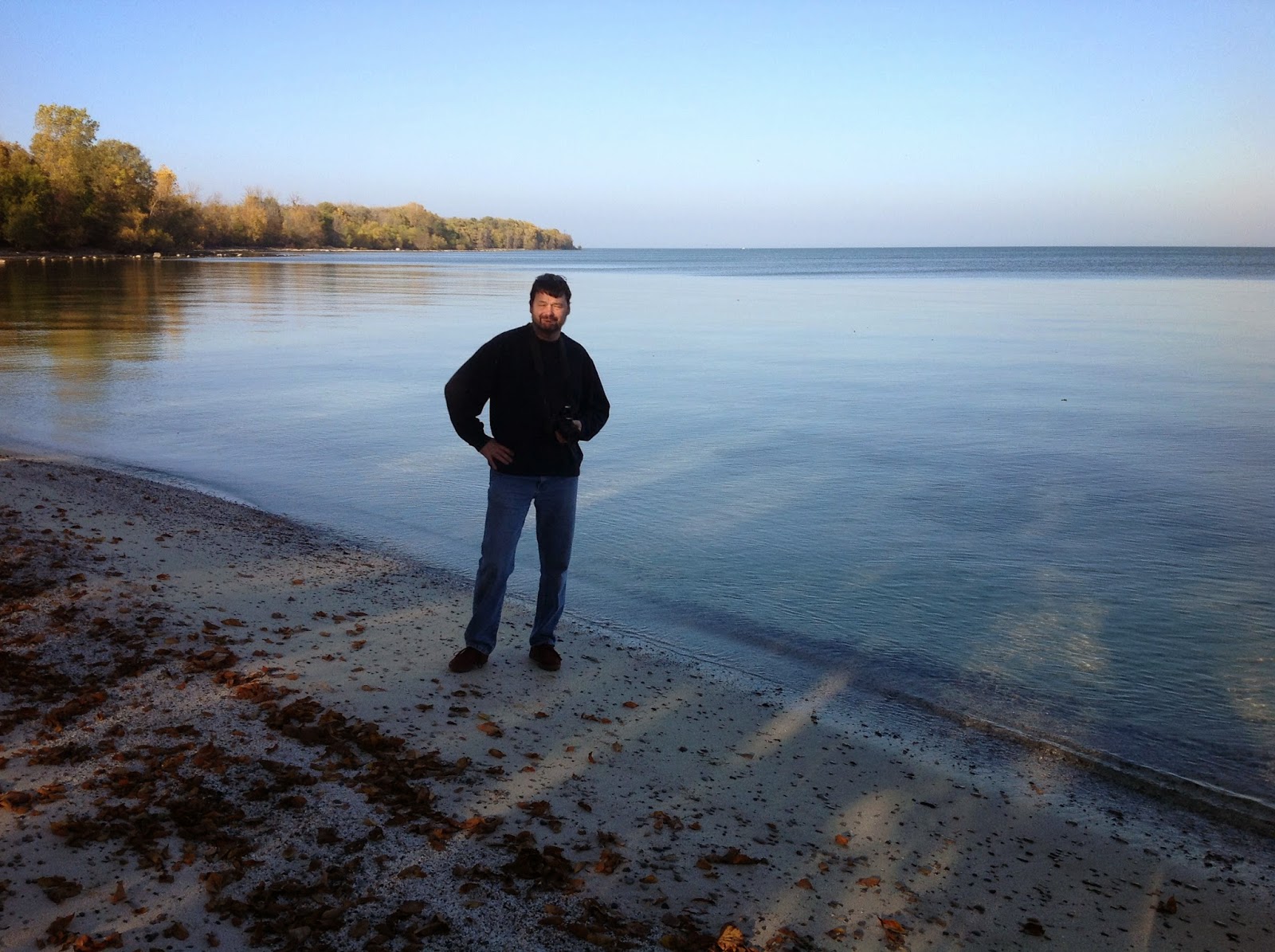
Roger stands by the clear water of the north shore as evening falls. We had perfect weather and the autumn leaves were at their peak. I hope we take these breaks more often. I realize too that the ability to take such Sabbaths bespeaks privilege--and that should not be.
Wednesday, October 15, 2014
Theopoetics II: A Reading of Amos Wilder's Theopoetic
I am reading Amos Wilder's seminal 1976 book, Theopoetic. Theopoetics, which I will define as the intersection of the literary with the theological, the manifestation of faith in art, has come to forefront as I have been thinking about Quaker literature. I will, therefore, be working through Theopoetic in light of its relevance for Quakerism.
In Theopoetic, Wilder begins with what theopoetics is not. First, it's not a shallow aestheticism. It's not ornamentation nor is it window dressing that prettifies religion by making it look more beautiful on the outside. It emerges from "the essential dynamics of the heart and soul." (2) Second, while it does not supersede love and action, it "orients" and "empowers" action. Third, a truly powerful theopoetic is neither sentimental nor nostalgic. Instead, a generative theopoetic is exorcising and revelatory: it challenges us, presumably by changing how we see ourselves or the world. Finally, it is not meant to displace but to enhance and enlarge tradition theology. (3) Part of that enrichment involves taking seriously secular literary criticism. (4) Renewing faith through renewing language is not a quick fix nor is it easy. "It is a costly transaction and cannot be manipulated." (5)
Wilder notes that the work of the greatest theologians has been "shot through with the imagination." He lists Augustine, Calvin and Jonathan Edwards. (3) We might add to that list George Fox, John Woolman and Thomas Kelly.
In part II of chapter 1, Wilder mentions several motifs in the contemporary world he believes not adequately addressed in the current religious imagination. The first he calls a "hunger for innocence and naivete." (7) Another is the transformative "experience of glory" or "intoxication." The intoxication theme also includes the "revolt of the beggars or vagabonds." Finally, he mentions the apocalypse, noting the "vision of an End can mean catastrophe to some, a new heaven and new earth to others." (10)
Quaker literature has been preoccupied in the last two centuries with a "hunger for innocence of naivete"--but in ways that look backward nostalgically rather than forward to become exorcising and revelatory. The social justice theme expressed in the revolt of the beggars, with its promise of transformative Jubilee, has been another Quaker preoccupation, but in its work in the world rather than its fiction. Would Quakers be better equipped for effective work with a more creative fiction? Finally, Quakerism is founded on a apocalyptic vision of a new heaven and new earth emerging in the present moment. We live on the fumes of that vision today, but do little imaginatively to express this ecstatic future as a counterweight to the dark forebodings that dominate our times.
A Quaker fiction of the heart and soul would shatter us, not soothe us.
In the last section of this chapter, Wilder mentions the mingled joy and suffering at the root of the Christian experience. This is captured by the term kreuzseligkeit or "blessedness in the cross." This results not in "a masochistic cult of suffering" but invites participation in the divine activity, sometimes including suffering, through which evil is "encountered and transmuted." (11) This experience is social and communal and woven into the fabric of everyday life "so that glory is associated with both its labor and its redemptive costs." (12)
Wilder finds limitations in the 1960s conception of "transcendence or ecstasy" because this vision lacks the spiritual courage to embrace the suffering inherent in the battle with evil. Both liberals and evangelicals, each caught in outmoded stereotypes, would do well to return their vision to the cross "in a way that would speak to all." (12)
In Theopoetic, Wilder begins with what theopoetics is not. First, it's not a shallow aestheticism. It's not ornamentation nor is it window dressing that prettifies religion by making it look more beautiful on the outside. It emerges from "the essential dynamics of the heart and soul." (2) Second, while it does not supersede love and action, it "orients" and "empowers" action. Third, a truly powerful theopoetic is neither sentimental nor nostalgic. Instead, a generative theopoetic is exorcising and revelatory: it challenges us, presumably by changing how we see ourselves or the world. Finally, it is not meant to displace but to enhance and enlarge tradition theology. (3) Part of that enrichment involves taking seriously secular literary criticism. (4) Renewing faith through renewing language is not a quick fix nor is it easy. "It is a costly transaction and cannot be manipulated." (5)
Wilder notes that the work of the greatest theologians has been "shot through with the imagination." He lists Augustine, Calvin and Jonathan Edwards. (3) We might add to that list George Fox, John Woolman and Thomas Kelly.
In part II of chapter 1, Wilder mentions several motifs in the contemporary world he believes not adequately addressed in the current religious imagination. The first he calls a "hunger for innocence and naivete." (7) Another is the transformative "experience of glory" or "intoxication." The intoxication theme also includes the "revolt of the beggars or vagabonds." Finally, he mentions the apocalypse, noting the "vision of an End can mean catastrophe to some, a new heaven and new earth to others." (10)
Quaker literature has been preoccupied in the last two centuries with a "hunger for innocence of naivete"--but in ways that look backward nostalgically rather than forward to become exorcising and revelatory. The social justice theme expressed in the revolt of the beggars, with its promise of transformative Jubilee, has been another Quaker preoccupation, but in its work in the world rather than its fiction. Would Quakers be better equipped for effective work with a more creative fiction? Finally, Quakerism is founded on a apocalyptic vision of a new heaven and new earth emerging in the present moment. We live on the fumes of that vision today, but do little imaginatively to express this ecstatic future as a counterweight to the dark forebodings that dominate our times.
A Quaker fiction of the heart and soul would shatter us, not soothe us.
In the last section of this chapter, Wilder mentions the mingled joy and suffering at the root of the Christian experience. This is captured by the term kreuzseligkeit or "blessedness in the cross." This results not in "a masochistic cult of suffering" but invites participation in the divine activity, sometimes including suffering, through which evil is "encountered and transmuted." (11) This experience is social and communal and woven into the fabric of everyday life "so that glory is associated with both its labor and its redemptive costs." (12)
Wilder finds limitations in the 1960s conception of "transcendence or ecstasy" because this vision lacks the spiritual courage to embrace the suffering inherent in the battle with evil. Both liberals and evangelicals, each caught in outmoded stereotypes, would do well to return their vision to the cross "in a way that would speak to all." (12)
Subscribe to:
Posts (Atom)